
Globe One · live
Prepaid eSIM without the shop
A competitor was moving and our prepaid rollout had already slipped. Then the journey we'd designed hit the one system we couldn't redesign away.
Design lead
What changed
- 2xconversion versus physical SIM
- <3 minpurchase to a live eSIM
- −20%activation support tickets
The constraintShip self-serve activation into an app that was never designed to sell connectivity, on legacy rails, while every new number still had to clear Philippine government ID verification.
The challenge
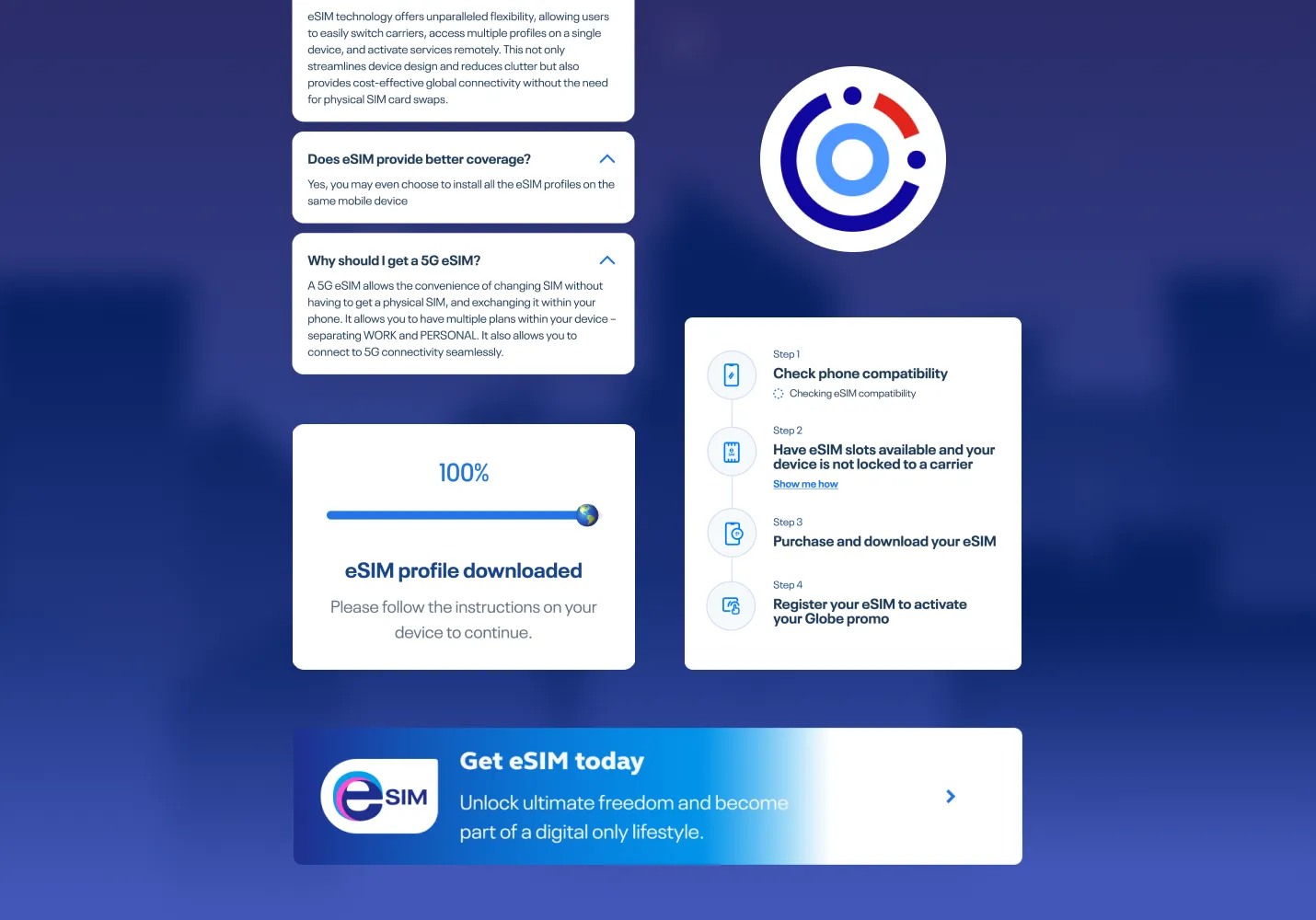
Globe One already had millions of people in it. Physical SIM activation assumed a person in the loop, a shop, a queue, a handoff, and every one of those was a place to drop out. eSIM was the way to sell connectivity without that, and most people in the market had never used one.
A traveller eSIM already existed, and it had an easier problem to solve: a tourist buying a local number does not need to be verified against a Filipino government identity system, so that flow could live almost anywhere, including outside the app. Prepaid was for Globe’s own customers, which meant Philippine SIM registration law applied, and every new number had to clear a government ID check. Prepaid also had to sit inside everything existing customers already knew, on rails that were never built to sell a SIM. A competitor was moving, and our own rollout had slipped.
The obvious response was to compress the existing plan. That would have shipped a worse version of what was already late. Stakeholders also wanted discovery to be immediate: eSIM had to be one of the first things a person noticed, for new customers and for people already in the app.
What we did
I led design with a product manager, a delivery manager, two frontend engineers, and three backend engineers, alongside stakeholders at Globe and Amdocs.
- Made eSIM understandable inside Globe One
- Designed the government ID verification step honestly instead of hiding it
- Checked the device before anyone paid
- Rebuilt purchase, install, and activation as one sitting
- Cut the release into three stages on legacy rails
Where the ideal journey met local reality
The journey we wanted was the traveller one: buy, download, activate, done, in one sitting. We found out mid-project that Prepaid could not be that, because the government ID verification system Philippine telcos are required to check against did not talk to what we were building the way we needed it to.
We could not make that verification step invisible. What we could hold onto was the promise underneath it: the benefits of eSIM did not change, and neither did the requirement that a person could finish without a shop. What changed was that we designed the extra step honestly, telling people what it was and why it was there, rather than letting it read as our journey breaking.
That also meant closing every edge case around discovery before it became a support ticket: where a new customer versus an existing customer would first see eSIM inside Globe One, and a compatibility check up front, so an incompatible phone or an ID mismatch surfaced early instead of at the point of activation.
Purchase to a live eSIM
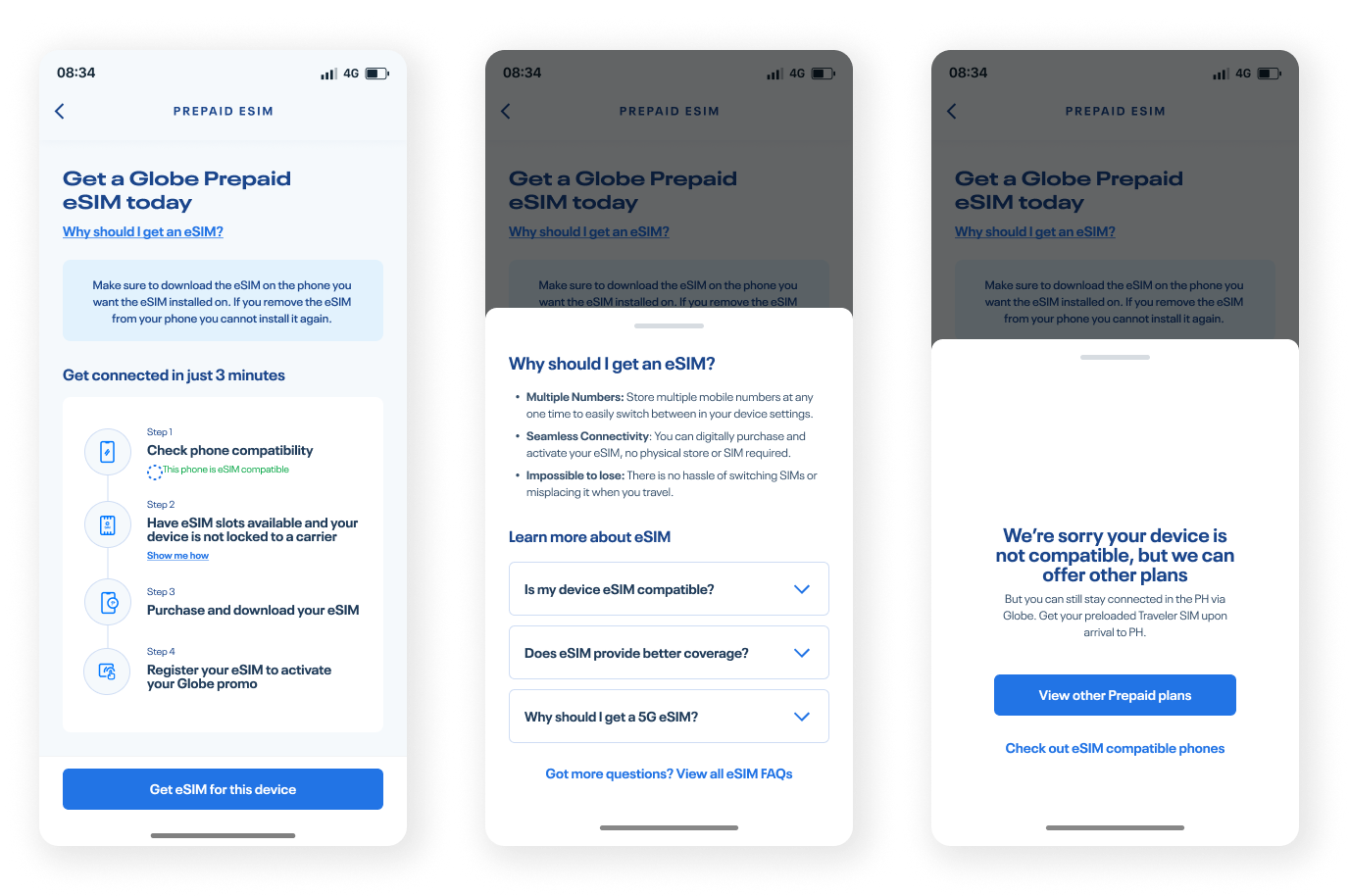
We put a short educational landing and an FAQ in front of purchase, then the device check, so an incompatible phone stopped in the app instead of after a shop visit. People who could not install still left knowing what they would get on the next handset.
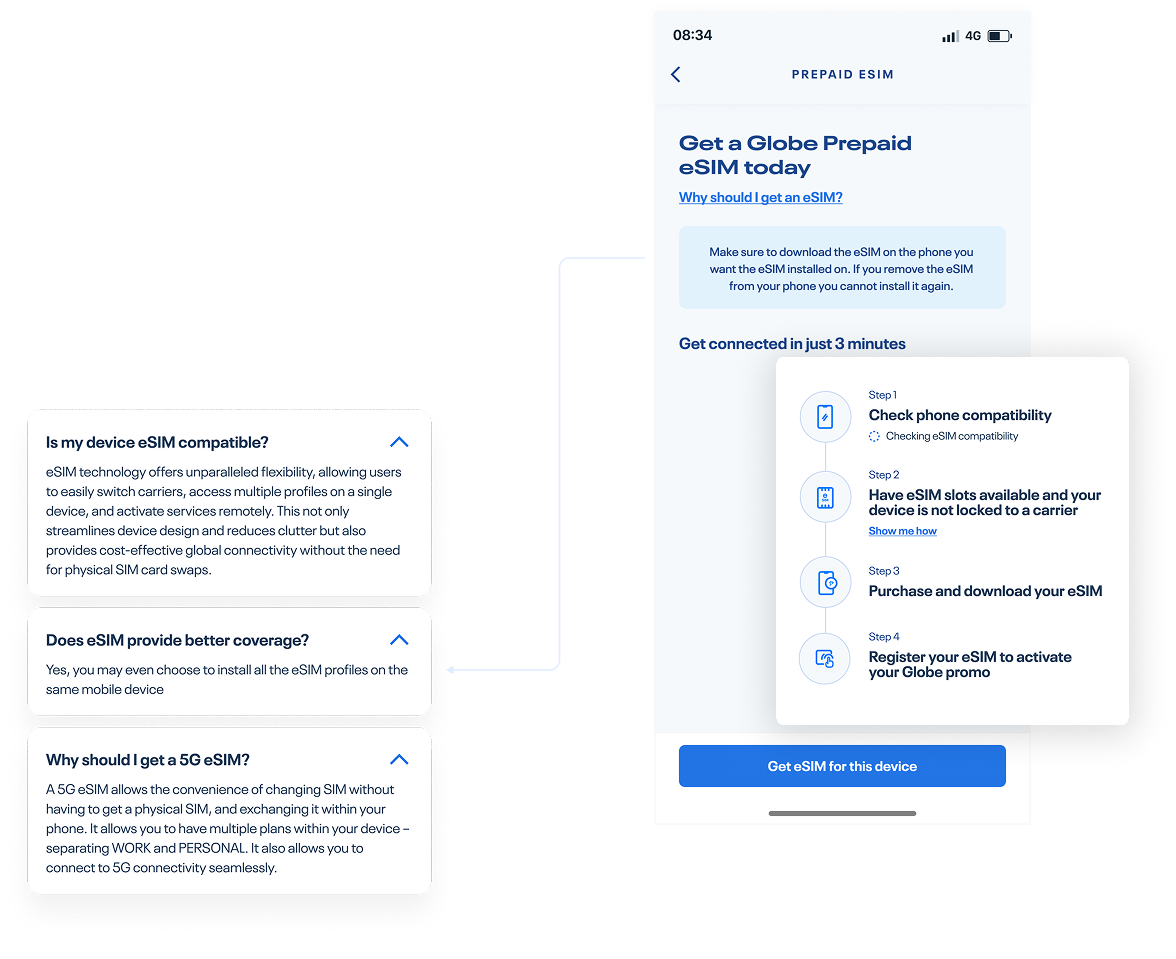
Physical SIM had treated install as someone else’s problem. We treated it as the product: purchase, ID verification, download, and activation had to complete in one sitting, inside the app, without a human in the loop. The screens that mattered were the ones that failed, a phone that could not take an eSIM, a verification that did not clear, a download that did not start, and those were the steps we removed or made honest.
What we cut to ship
Feasibility problems from the traveller work came back once we were inside the legacy app. The full story, automatic download, then a switch from physical SIM on the same phone, would have waited out the window we had.
We split the release in three. The MVP was self-serve prepaid for people whose device could take it and whose ID cleared cleanly. Later stages could add the rest. Shipping a journey that finishes was more important than shipping the whole roadmap on time.
What it moved
Conversion doubled against physical SIM. Most people who started, finished in one session, in under three minutes, government ID step included. Activation support contacts fell by a fifth, the number that mattered internally, because it was evidence the journey finished without help.